

Introduction
You type a prompt into Midjourney or DALL-E. Seconds later, an image appears. It’s impressive, sometimes beautiful. But something feels hollow.
Meanwhile, across the digital landscape, an artist sits with Python or Processing, writing thousands of lines of custom code. They iterate for weeks, testing parameters, refining algorithms, embedding their artistic vision into the logic itself. When their generative artwork is minted on Art Blocks, collectors pay premium prices sometimes millions.
Both produce algorithmic imagery. Both use computation. Yet the art world, collectors, and increasingly the law itself are drawing a sharp distinction: one has soul, the other is a parlor trick with marketing.
This isn’t gatekeeping. It’s a fundamental difference in creative intent, authorship, and authentic expression. And understanding why matters whether you’re an artist deciding your path, a collector allocating capital, or simply someone curious about what art will actually mean in the algorithmic age.
The Core Problem: What AI Art Actually Is (And Isn’t)
Before we can talk about what generative art offers that AI art doesn’t, we need clarity on what “AI art” actually means.
When you use DALL-E, Midjourney, or Stable Diffusion, you’re not creating art. You’re prompting a machine learning model trained on billions of images scraped from the internet. These models are black boxes you have no insight into how your text becomes an image. The algorithm’s decisions are opaque to you. You refine your prompt, and iteration feels like creation, but fundamentally, a pre-trained neural network is making the generative decisions.
Here’s the critical legal and philosophical distinction: according to the U.S. Copyright Office, works generated by AI have no copyright because copyright must attach to a human author. The prompt you write isn’t considered sufficiently creative labor to meet copyright threshold. The model itself cannot hold copyright. So who owns the output? Legally, it remains murky a regulatory vacuum rather than a solved problem.
There are also serious ethical concerns. These models trained on billions of images, often including copyrighted artwork, without artist permission or compensation. Artists have sued for unauthorized training data use. The system itself, regardless of the output quality, rests on a foundation of potentially stolen intellectual property.
But the aesthetic and philosophical problem is deeper: prompt-based AI lacks intentionality. The user doesn’t design the system; they direct a pre-existing system. There’s no creative vision embedded in the architecture just clever prompt engineering.
What Generative Art Actually Is
Generative art is fundamentally different.
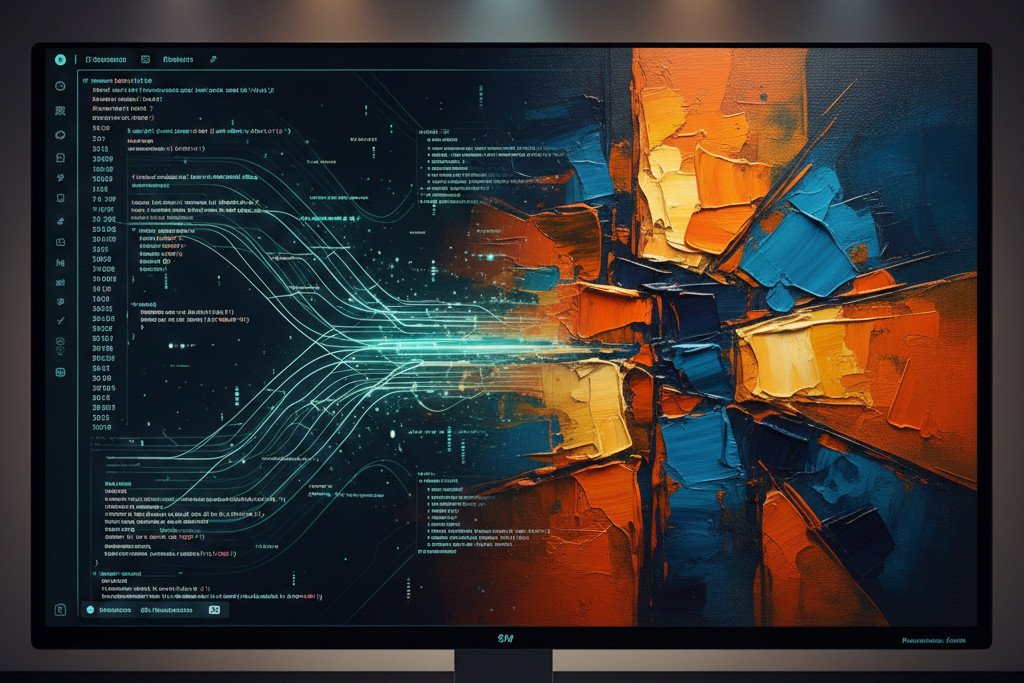
In generative art, the artist writes the algorithm. You don’t prompt a model; you code a system. You design rules, parameters, mathematical functions, and control structures from scratch or deeply customize existing frameworks. You test outputs, iterate on the logic, and deliberately embed your aesthetic vision and creative intent into the algorithmic code itself.
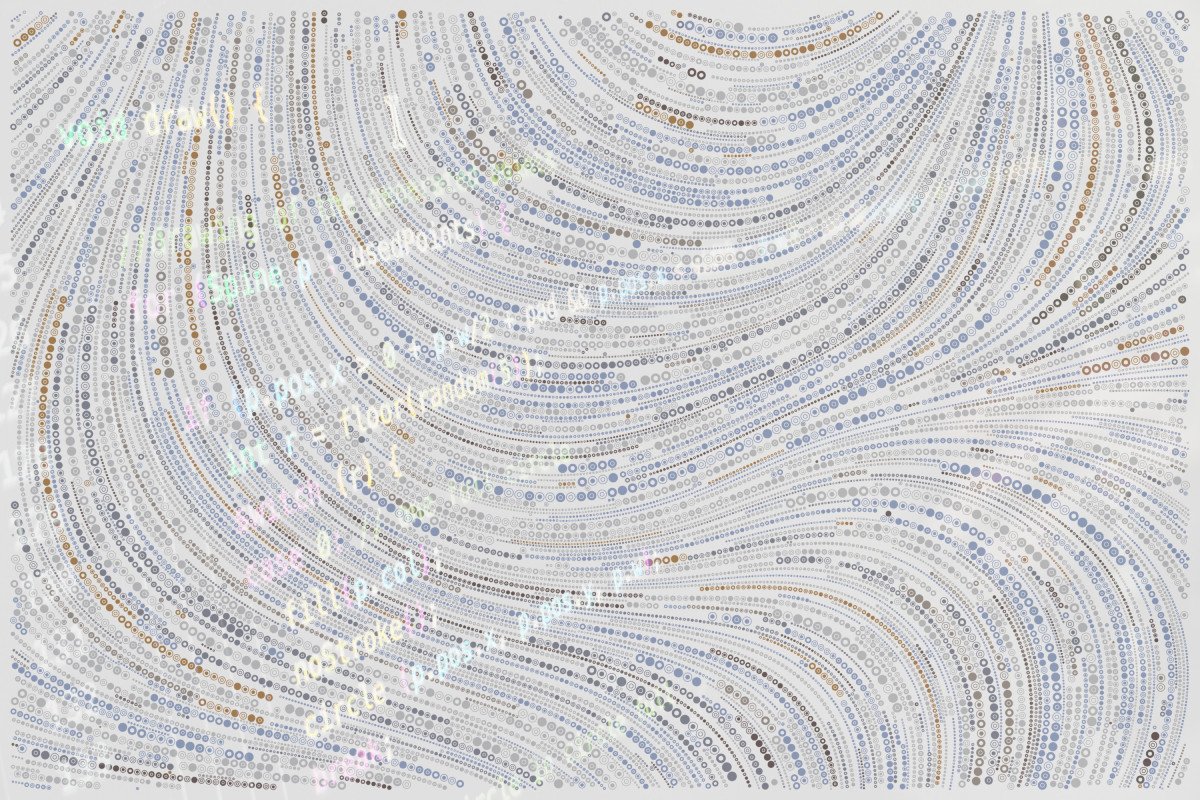
When Tyler Hobbs created Fidenza, he didn’t ask an AI to make flowing curves. He wrote code that generated curves according to his specific artistic philosophy. Every parameter, every mathematical relationship, every interaction between elements reflects his creative choices. The algorithm is an extension of his artistic voice.
When you code generative art, the “rules” of your system are your artistic statement. The randomness you introduce, the probability distributions, the color relationships, the compositional constraints all of it is intentional design.
This is why custom-coded generative art attracts serious collectors and commands premium prices. You’re not buying the random output of a training dataset. You’re buying the artist’s entire system, encoded on the blockchain, reproducible forever, yet generating infinite unique variations.
The Soul Factor: Intent, Authorship, and Emotional Depth
Here’s what research reveals about why people value human-created art including human-coded generative art so much more than prompt-based AI:
The Authorship Problem
In a landmark study from Columbia Business School, participants valued art labeled as “human-made” at 62% higher prices than art labeled “AI-generated,” even when the aesthetic quality was comparable. When asked why, participants consistently pointed to perceived creativity, labor, and emotional authenticity.
Why? Because human authorship implies intent, vision, and personal stake. When you write custom code for generative art, every function, every parameter you tweak, every philosophical decision you embed represents your creative labor and vision. There’s a continuous through-line from your imagination to the final system.
With prompt-based AI, that thread is broken. You’re directing a black-box system designed by engineers you’ll never meet, trained on data you don’t understand, making decisions you can’t control. The model doesn’t care about your vision; it cares about pattern-matching against its training data.
Copyright Clarity
This distinction matters legally. Under current U.S. law, generative art created through custom code and algorithms can be copyrighted if there is substantial human creative input in the system design. The artist of such work holds intellectual property rights. They control distribution, monetization, and reproduction.
Prompt-based AI art? Legally uncopyrightable under current interpretation. You own nothing. You can’t prevent others from using your prompts to generate identical imagery. You have no legal claim to the output.
This uncertainty cascades through the market. Seasoned art collectors the ones with serious money and discernment have overwhelming avoided prompt-based AI art. Only 2% have purchased it, while 29% might consider it in the future. But for generative NFT art on platforms like Art Blocks? Billions in trading volume, with elite works commanding prices in the millions.
The market is voting with capital: it values authorship and intentional creation.
The Emotional Connection: Generations, Not Prompters
Research on emotional responses to generative art reveals something fascinating: custom-coded generative art evokes deeper emotional engagement than both static images and prompt-based AI output.
Why? Because generative artists embed meaning into the system itself. They choose color palettes deliberately. They design compositional constraints intentionally. They write algorithms that create emergence complexity that arises from simple rules, producing outcomes that feel alive and organic precisely because the artist orchestrated the conditions that create them.
When you view a piece of Fidenza or a custom-coded generative work, you’re experiencing the artist’s entire philosophy translated into computational form. The soul is there not in the image, but in the system that generates infinite variations.
Contrast this with a Midjourney output: you see a prompt’s result, a pattern-match against training data. It may be visually sophisticated, but there’s no artist voice behind it no intentional emotional architecture, no personal vision encoded into the generation process.
A study examining emotional responses to generative art found that participants experienced heightened awareness and emotional engagement when interacting with works designed with deliberate compositional and philosophical intent. The “soul” emerges not from the pixels but from the design of the system that generates them.
Why Collectors Distinguish (And Price Accordingly)
The market premium for custom-coded generative art reflects rational collector behavior:
1. Authenticity and Provenance
When you acquire a generative artwork on Art Blocks or a blockchain-based platform, the algorithm is written directly to the smart contract, immutable and public. You’re not just owning an image; you’re owning a piece of the code itself. You can verify the artist created it, examine the algorithm, and understand exactly how the system works.
With prompt-based AI art, there’s no provenance chain. Anyone can type the same prompt into Midjourney and generate something identical or very similar. There’s no scarcity model. There’s no verifiable authorship.
2. Scarcity with Permanence
A custom-coded generative system can produce infinite outputs each unique, each valid. Yet the system itself is singular and permanent. Collectors aren’t competing for the “1 of 1” static image; they’re co-owning a piece of the artist’s generative philosophy, stored forever on the blockchain.
This is a fundamentally new form of ownership in art history. You don’t own “the painting” you own a deterministic hash within an algorithm that will produce the same output forever, yet belongs uniquely to you.
3. Curator’s Vision
When a generative artist writes custom code, they curate the possibility space. They decide what colors are possible, what compositions can emerge, what variations exist within their system. This curatorial vision is precisely what collectors pay for.
Prompt-based AI offers no curation. The training dataset is the curator, and it’s designed by engineers optimizing for plausible outputs, not artistic coherence.
The Empirical Gap: Market Pricing Reflects Value
The numbers tell the story:
- Human-created artwork valued 15-25% higher than AI art by study participants
- When explicitly labeled as “human-made” vs “AI-generated,” human art commands a 62% premium
- Of seasoned art collectors, only 2% have purchased prompt-based AI art, while 29% might consider it
- Generative NFT market (Art Blocks et al): $1.3 billion+ in trading volume
- Record-breaking generative art sale: Ringers #879 (custom code by Dmitri Cherniak), $6.2 million at Sotheby’s
The contrast is striking: custom-coded generative art commands auction-house prices and museum interest. Prompt-based AI art attracts new, younger collectors but struggles to establish resale value or long-term appreciation.
This isn’t because prompt-based AI images are always ugly they can be quite impressive. It’s because collectors, curators, and the art market recognize that there’s no authorship behind them.
The Intent Question: What Makes Art “Soul”?
Philosophers and researchers increasingly argue that the “soul” of art isn’t in the finished product it’s in the intentionality and system design.
When you code generative art, you’re making thousands of micro-decisions:
- What probability distributions govern the appearance of elements?
- How do components interact and constrain each other?
- What range of color palettes is possible?
- How much randomness creates novelty without chaos?
- What mathematical functions express my artistic voice?
Each decision is an act of creative will. The artist’s taste, intuition, philosophy, and personal aesthetic are embedded in the algorithm itself. Someone familiar with your work can “hear” your voice in your algorithms the same way you can recognize a Basquiat or a Rothko.
With prompt-based AI, there’s no such opportunity for voice. The training data and neural network architecture designed by people you’ll never know—mediate between your intention and the output. Your “prompt” is more like a very specific library search query than an act of creation.
Isn’t It All Just Algorithms?
One might argue: “Both are algorithms. Both produce images. Isn’t the distinction artificial?”
No. Here’s why:
Generative art = The artist is the system designer. The creative act is writing the algorithm itself. The output is a consequence of that design. The artist’s vision is embedded in the logic.
Prompt-based AI = The user is the system operator. The creative act is directing a pre-trained model via natural language. The system’s design is opaque and beyond the user’s control. The user’s vision is filtered through a black box.
It’s the difference between a composer writing a symphony and a DJ selecting pre-recorded songs. Both involve sound and sequence, but the creative agency is entirely different.
The art world understands this distinction. Major auction houses like Christie’s and Sotheby’s now feature generative art in contemporary art auctions custom-coded work alongside painting and sculpture. They don’t feature Midjourney outputs in equivalent prestige sales. The institutional art world has made its judgment: one is art, one is design output.
The Copyright Question: Who Actually Owns This?
This matters enormously for artists and collectors.
Generative Art (Custom Code):
- The artist owns the algorithm and can copyright it
- Ownership is legally clear and enforceable
- Collectors can sell their pieces with full property rights
- Blockchain registration (on Art Blocks, etc.) provides permanent, immutable provenance
Prompt-based AI Art:
- No copyright protection under current U.S. law
- Ownership is legally ambiguous
- DALL-E assigns rights to the prompt creator, but terms are unclear
- Midjourney only assigns rights to paid subscribers; free users own nothing
- Any terms of service can change, leaving ownership claims vulnerable
If you’re a collector investing in art for appreciation or legacy, this distinction is critical. Custom-coded generative art offers legal clarity and permanence. Prompt-based AI offers uncertainty and regulatory risk.
The Contradiction: Why Collectors Still Buy AI Art
Here’s the paradox: while seasoned collectors avoid prompt-based AI, younger and newer collectors are entering the market through it. Why?
Accessibility: You don’t need to understand code or have technical skills to use Midjourney or DALL-E. The barrier to entry is a credit card and curiosity.
Novelty appeal: The technology is new, visually impressive, and there’s a cultural moment around AI right now. Early adopters find that appealing.
Lower cost: Prompt-based AI art is cheap to produce and inexpensive to purchase. It’s an accessible entry point to digital art collecting.
But here’s what the data suggests: these are first-time buyers, not serious collectors. The same way someone might buy an NFT of a meme and later realize they prefer art with institutional backing and lasting value. As the market matures, generative art (the kind with custom code, artistic vision, and legal clarity) will likely appreciate while commodity prompt-based outputs commoditize.
The Future: Algorithmic Authenticity
As custom coding becomes more accessible (tools like Processing and p5.js make it feasible), the distinction will become even sharper.
The next generation of generative artists will embed increasingly sophisticated algorithms not just visual patterns but interactive systems, AI-assisted design tools, real-time data feeds, and emergent behaviors. These systems will be orders of magnitude more complex and intentional than anything producible via prompting.
Meanwhile, prompt-based AI will become commoditized. Everyone will have access to the same models. The outputs, while sometimes lovely, will blur together. Without algorithmic distinctiveness or verifiable authorship, there’s no collecting thesis.
The art world’s trajectory is clear: authenticity and intent matter. Custom-coded generative art will mature into a major art movement, recognized and valued alongside painting, sculpture, and photography. Prompt-based AI will find its place as a design tool useful, but not art in the collector’s sense.
Conclusion: The Soul Is in the System
The “soul” of generative art isn’t in the finished image. It’s in the algorithm the artist wrote. It’s the thousands of intentional choices about how a system should generate emergence, the philosophical constraints that shape possibility, the aesthetic vision encoded in mathematical relationships.
When you own a piece of Art Blocks generative art, you’re not just looking at pixels. You’re engaging with an artist’s entire creative system one that will generate unique works forever, deterministically tied to the blockchain, with full legal ownership and clear provenance.
When you download a Midjourney image, you’re looking at a pattern-match against a training dataset. It’s impressive, sometimes beautiful but it’s not art. It’s design. The artist is the engineer who built the model, not the person who typed the prompt.
This isn’t elitism. It’s recognizing that art requires intentionality. And intentionality requires the artist to design the system itself.
The market, the law, the institutions, and serious collectors are all converging on this same conclusion. In the coming years, that distinction will only sharpen. The artists who write their own algorithms, who embed their vision into code, who design systems that generate infinite expressions of their singular creative voice—those artists will be remembered.
The prompt-givers? They’ll fade, replaced by the next batch of prompt-givers, indistinguishable from one another, commoditized into meaninglessness.
Because that’s what art actually requires: a soul. And a soul can’t be generated by a black box. It has to be coded into being by a human hand, a human mind, and a human vision.
Leave a Reply